THE WORK IN PRACTICE
Case Studies
Real Frameworks, real AI agents, real outcomes. Built from 15 years of enterprise CS practice - not generic templates.
1. Scaling CSM Coaching Without Bias or Bottlenecks
AI agent · CSM Coaching · Performance Standard
How it worked
1
Built the standard first - before any AI
An evidence-based performance baseline was created from 15 years of enterprise CS experience, senior CSM interactions and call shadowing, and industry best-in-class call standards. All validated by a human. Not generated by an algorithm.
2
Trained the AI agent on that standard
AI coaching agent was built and trained on the validated baseline — not generic CS frameworks. Every output was designed to reflect the organization's unique best in class standard, not replace it but advance it.
3
Validated every output before deployment
AI coaching output was evaluated against human practitioner judgment before any CSM received feedback. Accuracy checked, bias reviewed, standard confirmed. No unvalidated output passed through.
4
Scaled the standard across the entire team
Consistent, unbiased coaching delivered to every CSM — not just those with the most attentive managers. Skill development no longer dependent on manager bandwidth or personal coaching style.
Impact
100 %
Consistent coaching available to every CSM on the team
0
Manager bandwidth required to deliver structured feedback
150+
Years of collective senior practitioner experience embedded in the standard
The challenge
High-performing CSMs were setting an unspoken standard that the rest of the team had no visibility into and no structured path to reach. Coaching was manager-dependent, inconsistent across the team, and subject to unconscious bias. The best CSMs were carrying institutional knowledge that no one else could access. Leadership suspected a performance gap but had no consistent baseline to measure against and no scalable way to close it.
The solution
An evidence-based performance baseline was established from industry best practices and senior CSM interactions then validated before any AI was involved. A custom AI coaching agent was then built and trained on that validated baseline, not generic CS frameworks or unreviewed data. Every output was evaluated against human judgment before deployment. The result was consistent, bias-free coaching available to every CSM — with skill development no longer dependent on manager bandwidth, tenure, or personal style.
The origin
Leadership wanted to uplevel their CSMs but having every manager shadow calls was not feasible — and it introduced bias. CSMs would invite managers to their best calls, not their typical ones. When asked what the biggest skill gaps were across the team, leadership did not have that answer. There was no baseline and no consistent view of what good looked like.
The rubric came first. Working directly with senior ECSMs to define best-in-class performance, then validating those standards against industry benchmarks, created a practitioner-grounded baseline. Once that standard existed, the coaching agent could be trained against something real — not a generic framework, but an evidence-based standard that reflected what enterprise CS excellence actually looks like.
View a template report below. Note: Information is generic to protect proprietary information
2. Executive-ready deliverables in under 30 minutes.
AI agent · End of year summary · Executive engagement
How it worked
Data Inputs
-
Customer Emails
-
Call Transcripts
-
Product Roadmap
-
Technical Docs
Gainsight Dashboard
-
Activity Tracking
-
Contract Data
-
Feature requests
-
Success Plans
AI Agent
-
Trained on ECSM best practices & metrics
-
Practitioner framework
-
Cross referenced all inputs
-
Validated against dashboards
Executive Summary
-
Year in Review
-
Success Plan Recap
-
Product ROI
-
Prescriptive roadmap

Impact
80 %
Reduction in manual effort per deliverable.
<30 min
To produce an executive -ready summary.
100 %
Consistent quality scaled across ECSM team.
The challenge
CSMs were spending one to two hours per customer producing end-of-year executive summaries, manually pulling from emails, success plans, product roadmaps, and activity logs. Output was inconsistent and dependent on individual memory.
The solution
A custom AI agent was built and trained on a practitioner-designed document framework and ECSM best practices. It synthesized customer data across multiple sources and cross-referenced a custom Gainsight dashboard tracking all customer activities, contracts, feature requests, and workshop attendance.
The result was a polished, executive-ready summary that demonstrated ECSM value, product ROI, and prescriptive recommendations tied to the customer's roadmap, produced in under 30 minutes.
The origin
This deliverable started as a framework built entirely from scratch, including every section, the structure, and the information captured. A year later, the same framework was optimized with a custom AI agent to automate what had already been proven to work. Built once by hand. Then built to scale.
View a sanitized template example below. Note: formatting has been updated from the original deliverable to protect proprietary information
3. From Decks to Dialogue.
Prescriptive CS Engagement Model · Customer Journey Alignment· Success Planning
How it worked
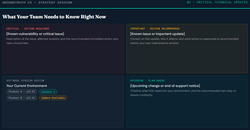
Each feature was presented as a story, not a slide. The goal was never to show a capability only, it was to understand what the customer was already doing, surface their concerns through discovery, then connect the capability to an outcome they already cared about. Every call ended with an agreed next action, not just a summary.
Part 1: The Prescriptive Storytelling Deck
 |  |  |
|---|---|---|
 |  |
Part 2: The Industry Framework Alignment Model

Industry specific pillars sit between key milestones. Each are applied based on where the customer is in their maturity, not a generic checklist.
CSMs update each pillar in the platform after every engagement providing more insights on adoption status and feature interest. Work between milestones becomes visible and reportable for the first time.
Industry examples:
Cybersecurity / Data Protection
NIST CSF | ISO 270001 | SOC 2
Conversations tied to audit readiness and compliance obligations
Healthcare
HIPAA | HITRUST
Capabilities aligned to patient privacy and regulatory obligations
Financial Services
SOX | PCI- DSS| DORA
Resilience tied to controls finance teams are already measured against
Customer Services / SAAS
ITIL | ISO 9001 | CSAT
Adoption aligned to service maturity and CS performance KPIs
Feature adoption becomes business alignment. The CSM speaks the language of audits, compliance, and KPIs - not just features and functionality.
The challenge
CSMs were showing up to customer calls with decks that listed features without context, discovery, or narrative. Customers received information. They did not have conversations. Leadership could track major milestones but had no visibility into what was happening between them or how impactful those touchpoints actually were.
The solution
Customer decks were redesigned around a five-part prescriptive storytelling structure. The feature story was the centerpiece — instead of presenting a capability, it opened a conversation. Discovery questions surfaced the customer's current state and KPIs. Peer examples or research papers added context. Every call ended with a committed next action. A separate kickoff deck established the success plan foundation, surfacing the customer's baseline, purchase rationale, and a commitment to monthly cadences that would evolve the plan over time.
The Journey Model
When leadership invited me to join their Journey Team, the problem being solved was visibility into what happened between milestones. The recommendation was a maturity model built on industry frameworks and compliance standards — mapped to product capabilities and applied based on where each customer was in their journey. CSMs could update each pillar in the customer success platform with adoption status and feature interest, giving leadership the ability to report upward on what customers were adopting, discussing, or not yet ready for.
View a sample deck below. Note: formatting has been updated from the original deliverable to protect proprietary information, and information is only an example.